Coloring Page vs Zentangle vs Mandala: What's Actually Different?
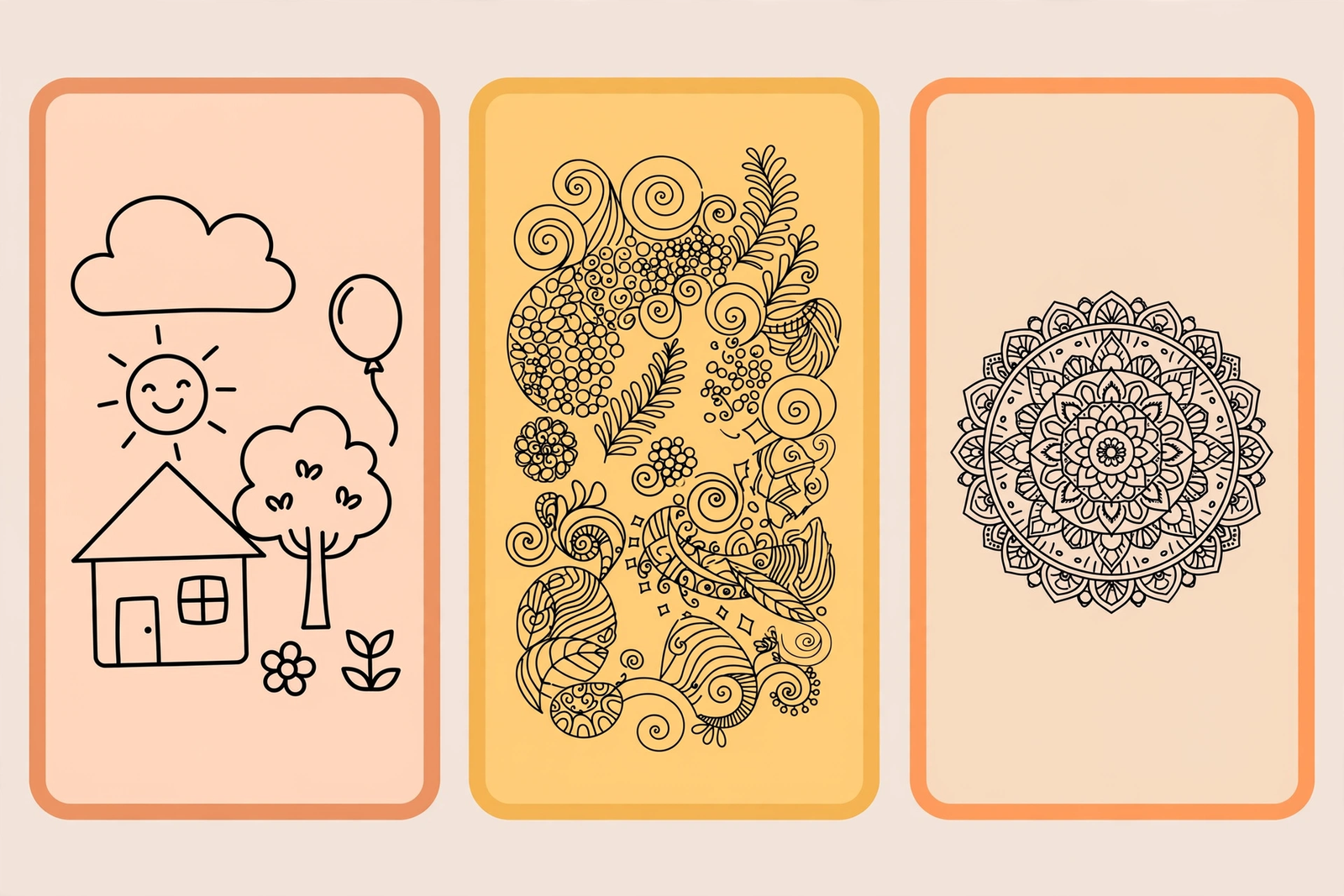
Same crayons, three very different experiences.
Walk through the printables aisle of the internet and you'll see the words coloring page, zentangle, and mandala thrown around as if they mean the same thing. They don't. Each one asks something different of you, and knowing the difference helps you pick the right sheet for a restless four-year-old, a stressed-out afternoon, or a quiet evening of focus.
A coloring page: a picture waiting for color
A coloring page is the broad category — any black-and-white line drawing you fill in. It usually shows a recognizable thing: an animal, a truck, a castle. The whole point is representation. A child sees a puppy and knows the fur should be brown and the bone should be white. Coloring pages come in every difficulty, from three big shapes for a toddler to detailed scenes for older kids, and they're the friendliest entry point because there's a clear "right idea" of what you're making.
A zentangle: pattern, not picture
A zentangle flips that on its head. Instead of coloring inside a picture, you build up an abstract composition from small, repeated patterns — dots, curves, grids, spirals — usually within a loosely divided square. There's no "correct" outcome and no subject to get right; the appeal is the rhythm of drawing (or coloring) the same little marks over and over. Printable "zentangle-style" sheets give you the sections and starter patterns so you can color each region differently. It's less about the finished image and more about the meditative act of filling space.
A mandala: symmetry and center
A mandala is a circular, symmetrical design that radiates out from a single center point. The word comes from Sanskrit for "circle," and the defining feature is that balance — whatever appears on one side is mirrored around the ring. Coloring a mandala feels different again: because it's symmetrical, many people color it symmetrically too, matching petals and rings, which creates a calming, almost hypnotic sense of order. Our mandala collection leans into this with detailed, evenly balanced patterns aimed at teens and adults.
Quick way to remember it: a coloring page is a thing, a zentangle is a texture, and a mandala is a circle.
Which should you choose?
Match the sheet to the moment. If a young child wants to color, reach for a representational coloring page with bold outlines — it's motivating because they can see what they're making. If you want to switch your brain off and don't care about the outcome, a zentangle is perfect; there's no way to "mess it up." And if you're after calm, structured focus — the kind of thing people describe as relaxing — a mandala's symmetry gives your attention somewhere gentle to rest. We look at that calming effect more closely in mandala coloring and focus.
Can they overlap?
Absolutely — and that's part of the fun. You'll find mandalas built entirely from zentangle-style patterns, or animal coloring pages with mandala-like decorative backgrounds. The labels are a starting point, not strict rules. Once you know what each term is really pointing at, you can read a page at a glance and know whether it'll suit the person, the mood, and the amount of time you've got.
Want to feel the difference yourself? Print one simple animal page and one mandala in the same sitting — the contrast between "coloring a picture" and "coloring a pattern" is the clearest teacher there is.